 $ AUD
$ AUD
Blog
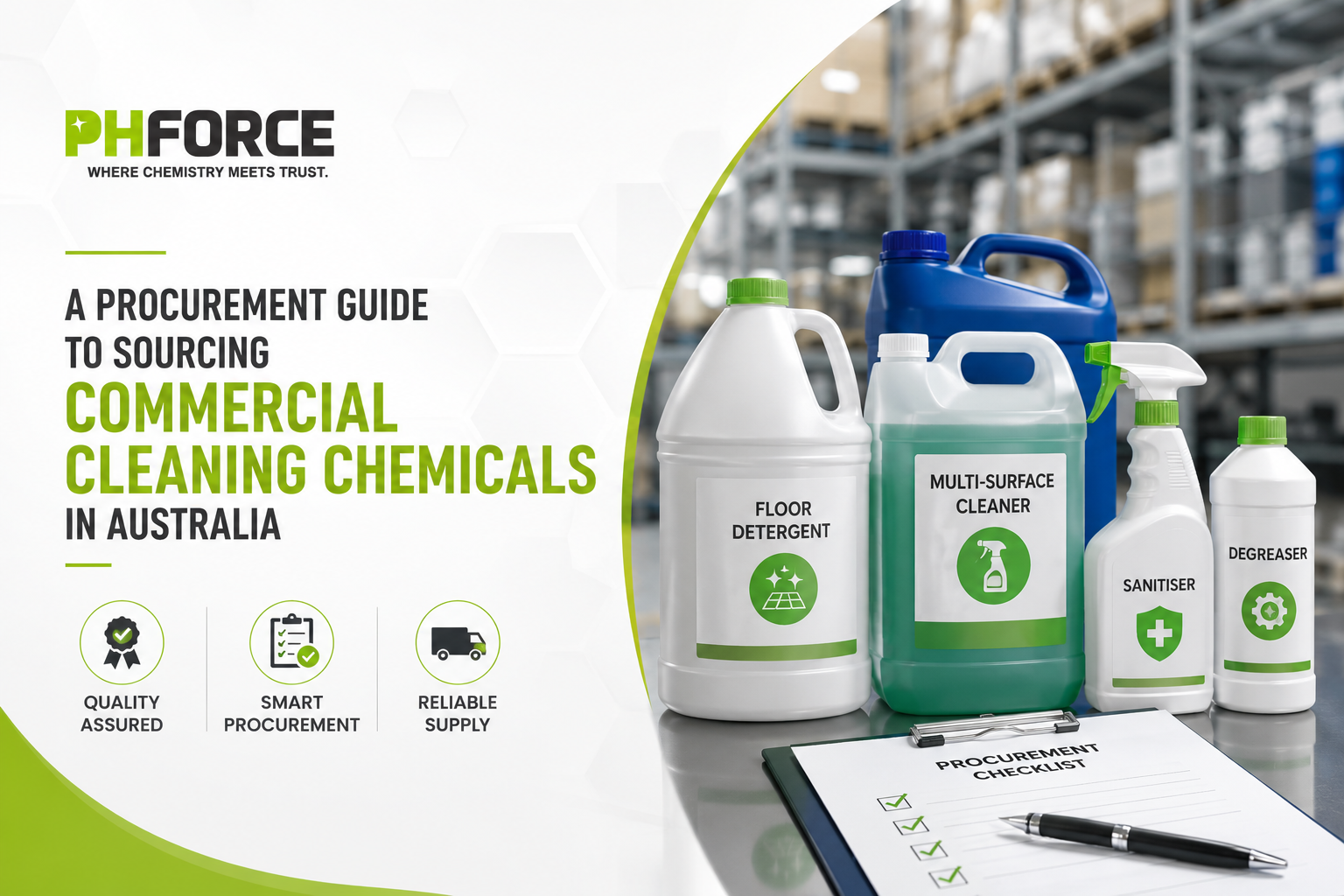
A Procurement Guide To Sourcing Commercial Cleaning Chemicals In Australia
Commercial chemical procurement is more than comparing prices between cleaning chemical suppliers. Australian businesses need to consider product performance, workplace safety, documentation, storage, environmental impact, delivery reliability and the requirements of their specific industry.
For procurement managers, facility managers and business owners, the right purchasing process can reduce chemical waste, simplify inventory management and prevent costly compliance problems. This guide explains what to assess before committing to a commercial chemical supplier in Australia.
1. Start With Your Facility’s Cleaning Requirements
Before requesting quotes, identify exactly what your facility needs to clean. Purchasing chemicals without understanding the application often leads to unnecessary products, inconsistent results and higher operating costs.
Build your purchasing list around:
- Surfaces: Floors, stainless steel, glass, tiles, food-contact surfaces and machinery may require different formulations.
- Soiling: Grease, oil, mineral scale, food residues and general dirt require different cleaning approaches.
- Cleaning frequency: Daily cleaning may require different products from periodic deep cleaning.
- Industry requirements: Hospitality, healthcare, manufacturing, education and food processing facilities can have different hygiene and safety considerations.
- Dilution requirements: Concentrated products may provide a more practical solution for businesses with regular, high-volume cleaning requirements.
This initial assessment gives your team a clearer specification for chemical purchasing for businesses rather than simply selecting products based on unit price.
2. Check SDS And Chemical Safety Documentation
Safety documentation should be a fundamental part of commercial chemical procurement. Australian workplaces using hazardous chemicals need appropriate information about their hazards, safe handling, storage and emergency procedures.
Ask suppliers for current Safety Data Sheets (SDS) before introducing new chemicals into your workplace. Leardon Chemicals, for example, provides an online SDS library covering products across categories such as laundry, floor care, washroom cleaning, oven and grill cleaning, carpet care and spray-and-wipe products.
When evaluating a supplier, check whether:
- SDS documents are readily accessible.
- Product labels correspond with the supplied SDS.
- Hazard classifications and precautionary statements are clearly documented.
- Staff can access the information they need before using the chemical.
- The supplier can provide updated documentation when formulations or regulatory requirements change.
Australia’s GHS 7 framework governs the classification and communication of hazards for workplace hazardous chemicals, making reliable documentation an important part of supplier evaluation.
3. Match Products To Industry Requirements
The cheapest general-purpose chemical is not necessarily the most suitable product for every facility.
For food-related operations, cleaning products should be selected according to the site’s food safety procedures and the surfaces being cleaned. Healthcare facilities may also require disinfectants with particular performance claims or regulatory status.
Importantly, not every commercial disinfectant requires ARTG inclusion. The TGA states that disinfectants making specific claims, such as activity against particular viruses, spores, tuberculosis, mycobacteria or fungi, require ARTG listing before supply in Australia.
Procurement teams should therefore verify the product’s intended use, claims and regulatory requirements rather than assuming that terms such as “hospital grade” automatically determine its legal status.
4. Evaluate Sustainability Beyond “Eco-Friendly” Claims
Environmental considerations increasingly influence chemical procurement Australia, but procurement teams should distinguish measurable environmental performance from general marketing language.
Independent certification can provide a stronger basis for comparison. GECA’s current Cleaning Products standard covers commercial cleaning products, dishwashing detergents, floor cleaners, general surface cleaners, laundry detergents and specialist industrial cleaning products.
When assessing sustainable products, consider:
- Independent environmental certification where relevant
- Packaging and container requirements
- Product concentration and transport requirements
- Biodegradability and environmental impact
- Waste generated during normal use
- Whether the product can meet cleaning requirements without excessive dosing
The objective is not simply to purchase the product with the strongest environmental claim. It is to select a product whose documented environmental performance fits your organisation’s procurement criteria.
5. Compare Suppliers, Not Just Product Prices
Effective bulk chemical sourcing requires a broader cost comparison than the price printed on a 5L container.
Assess the supplier against the full cost of supply:
| Procurement Factor | What To Compare |
| Product Cost | Price per usable litre |
| Freight | Delivery charges and minimum orders |
| Concentration | Dilution and cost per application |
| Supply | Stock availability and lead times |
| Support | SDS, technical advice and training |
| Packaging | Container sizes and waste |
A supplier offering a lower purchase price may not deliver the lowest operating cost if its products require higher dosing, generate more waste or attract expensive freight charges.
6. Consider Manufacturer-Direct And Specialist Suppliers
Businesses have several options for business chemical supply, including specialist distributors and manufacturer-direct accounts.
Specialist suppliers can simplify purchasing by providing multiple cleaning categories through one account. Manufacturer-direct purchasing may be particularly useful for businesses with recurring, high-volume requirements or specialised chemical needs.
Avoid selecting a supplier solely because it offers the lowest initial price. Assess its product range, documentation, availability, delivery capability and technical support before signing a supply agreement.
A Practical Commercial Chemical Procurement Checklist
Before placing your next order, confirm that the supplier can provide:
- Appropriate SDS documentation
- Clearly labelled commercial products
- Products suited to your industry and surfaces
- Transparent dilution instructions
- Reliable stock availability
- Competitive freight arrangements
- Suitable bulk sizes
- Relevant environmental certifications
- Technical or product support when required
Conclusion
Effective procurement of industrial chemicals protects more than your purchasing budget. It helps businesses control chemical consumption, maintain safer workplaces and create a more consistent cleaning programme.
Leardon Chemicals supplies commercial and industrial cleaning chemicals and packaging products across Australia, with product categories covering floor care, dishwashing, laundry, washroom hygiene, spray-and-wipe cleaning, industrial cleaning and more.
If you are reviewing your current chemical purchasing process, explore the available range and speak with the Leardon Chemicals team about finding practical products for your facility’s requirements.
Frequently Asked Questions
What Should Businesses Check When Buying Commercial Cleaning Chemicals?
Businesses should check product suitability, current SDS documentation, WHS requirements, dilution instructions, supplier reliability, pricing, freight and environmental credentials.
Is Buying Cleaning Chemicals In Bulk More Cost-Effective?
Bulk chemical sourcing can reduce the cost per unit, but businesses should also compare concentration, dilution rates, storage requirements, freight and product shelf life.
Where Can Businesses Source Commercial Cleaning Chemicals In Australia?
Businesses can source chemicals from specialist distributors or manufacturers, depending on their volume, product requirements, technical support needs and delivery locations.
Why Are SDS Documents Important When Purchasing Cleaning Chemicals?
SDS documents provide essential information about chemical hazards, safe handling, storage, PPE, first aid and emergency procedures, supporting safer workplace chemical management.